
Find Out Who Owns a Harrison County Parcel
Harrison County splits the ownership answer between two systems. The tax side moves fast. The official landroll links an owner-of-record name to a parcel number or PPIN, which makes it the quickest starting point. For stronger confirmation, turn to the recorded instrument in the Chancery Clerk's deed records, and keep the judicial district straight because Gulfport sits in District 1 and Biloxi in District 2.
- Search the street name in the landroll without its house number, directional, or road suffix; use at least three letters.
- Match the correct physical location, then save both its parcel number and PPIN with the displayed owner name.
- Search the Chancery Clerk land index for the newest deed to that grantee and compare the legal description.
- If the owner is an entity, preserve its exact legal spelling and check the official Mississippi business search for context.
This route shows what the public systems currently list for the Harrison County property. It does not prove occupancy. And it never replaces a full title examination.
Identify the Harrison County Owner in the Landroll
Four keys unlock the county landroll: owner name, street name, parcel number, and PPIN. Address search runs broad on purpose. Type the street name alone, not a full civic address. Name search takes a partial or full last name. Harrison County recommends the full last name plus a first initial. Common surnames crowd the results otherwise.
Owner of record means the name on the tax roll. Situs is the land's physical place, and a mailing address is where the tax bill goes. A grantee receives an interest under a recorded deed.
Once a row matches, the parcel number and PPIN are safer bridges than a name alone, and they carry you to the deed without guessing from the label. Coast surnames repeat. Entity names drift. Mailing addresses can sit far from the land.
Note: The landroll's street query drops house numbers, directionals, and suffixes, so confirm the exact parcel before trusting its owner field.
See the Harrison County Property Owner on the GIS Result
The Harrison County Property Search Application pairs a GIS map with land-roll data. It doubles as a cross-check. Result columns show Parcel ID, PPIN, Owner, Mailing Address, and Section-Township-Range, which separates parcels that share a street label or a family name. The county's parcel result page shows the layout.
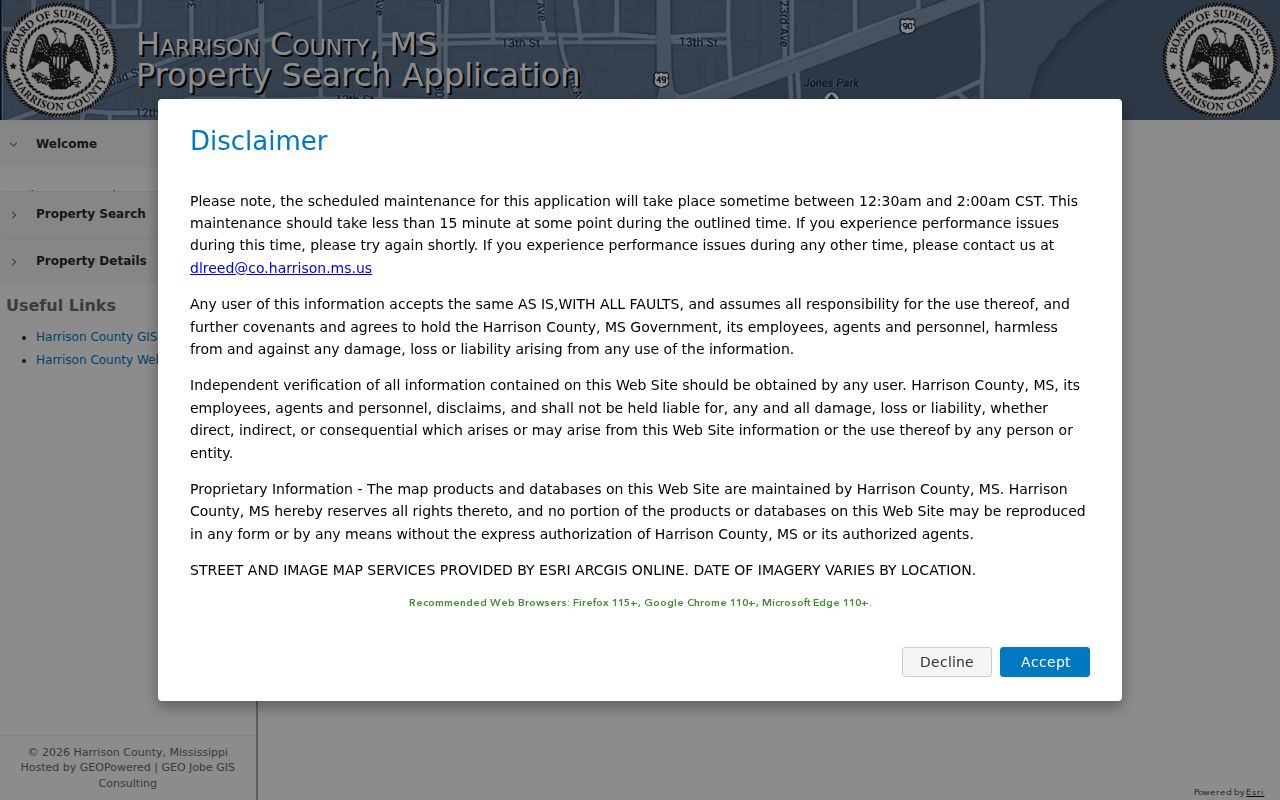
The method holds up on the map too. Pick the right parcel and note its keys. Those keys carry into the deed search, though the app warns that its imagery dates vary and its parcel data needs independent verification.
Trace the Harrison County Name to the Newest Deed
The assessor says whom the county bills. The deed index records a conveyance. Search the roll's owner as grantee, pick the newest relevant transfer, and compare its legal description or prior deed reference against the parcel. Names may disagree. Dates matter more than guesses there. Mississippi property tax is assessed to the owner of record on January 1. A late-year sale can leave the earlier owner on that year's roll even after a newer deed is recorded. Harrison County publishes no fixed post-closing update window, so count on no reliable day-count.
Record lead, not title proof. A roll name can lag a sale, and a deed index entry still is not a title opinion. Confirm legal ownership through the latest relevant instruments and qualified help when reliance matters.
Identify Harrison County LLC, Trust, and Estate Owners
A Harrison County parcel can sit under an LLC. It can also sit under a trust, an estate, a life tenancy, or several names at once. Copy the wording exactly as displayed. For companies, the Mississippi Secretary of State Business Search helps. Enter an organization name, an individual name, or a file number. That pins down the formal entity behind a landroll entry. Trusts and estates follow a different trail. A deed may name a trustee or life tenant. An estate transfer can involve a Chancery cause number, a will, a court order, or an executor deed. The county's online estate index is incomplete, so a missing match settles nothing. When probate is part of the chain, ask the Chancery Clerk for the whole file.
Where Harrison County Property Ownership Appears
No single portal holds every answer. Each Harrison County source contributes one fact, so read the landroll, GIS map, and deed records together.
| Harrison source | Ownership clue | How to reach it |
|---|---|---|
| Official landroll | Tax-roll owner plus street, parcel, and PPIN search keys | Free county web search or Tax Assessor office |
| GIS property application | Owner and mailing label tied to a mapped parcel | Free viewer; verify dynamic details |
| Chancery land index | Grantee named in the recorded conveyance | Current and historic web indexes; Clerk copy service |
| Mississippi business search | Formal company identity behind an entity name | Official state web search |
When the web fails, phone the Tax Assessor in District 1 at 228-865-4077 or visit the Gulfport or Biloxi counter. Deeds work differently. The Clerk routes researchers to recording and vault staff instead. The Gulfport vault is closed to walk-in visits. A parcel number, district, instrument reference, and date make any deed records request far more useful.
Monitor a Harrison County Property Owner Name for Fraud
Forged instruments and "house stealing" drew a warning from the Chancery Clerk. It links a Deed and Mortgage Fraud Alert Service. An alert is not a freeze. Nor does it certify a flagged filing as valid. Use the current county page for exact signup fields and delivery details. If an unexpected instrument appears, save its reference. Contact the Clerk through an official county number, never one supplied in an unsolicited message. A suspicious record calls for the Clerk, legal counsel, and possibly law enforcement, not an informal confrontation.
Know the Limits of a Harrison County Owner Lookup
A public owner of record entry has firm limits. It does not show who lives in the home. It does not reveal who may sign a contract. It does not confirm whether the title is clean. An unrecorded interest can sit outside the record entirely. The mailing address may belong to an agent, a trustee, a manager, or an out-of-area owner. So it is not proof of residence. Mississippi's Address Confidentiality Program can also substitute a mailing address for a qualifying protected person.
Use the public trail for purchase diligence. Use it for estate work, boundary questions, deed-fraud monitoring, or a respectful property contact. The county's map and assessment systems are reference tools, nothing more. A deed record is a stronger transfer clue than an assessment name. But reaching a complete title conclusion takes far more than one owner name on a screen.
Lawful use. Harrison County owner records support legitimate property research and civic transparency. Never use an owner name or mailing address to stalk, harass, threaten, or harm anyone.
Request a Harrison County Ownership Record Offline
A portal may be unavailable, or an owner result may look incomplete. Ask the office that holds the record. The Tax Assessor can address the landroll and parcel card. The Chancery Clerk handles deeds, plats, estate files, and recorded instruments. Older material may live at the library or MDAH instead of a modern web search.
Harrison County's written public-record form accepts email or delivery. It asks for a date range, a description, the desired format, and a delivery method. Include the parcel number, PPIN, district, and record type whenever known. Add the instrument or book and page too. County policy allows an estimate for search, review, redaction, storage retrieval, and mailing. Paper copies are listed at $0.50 per page. Deed images may use a separate purchase route.
This fallback can retrieve a record that exists. County staff need not create a new ownership report. They need not decide a title question either.
When calling, state the goal. It might be the current assessment name. Or it might be a newly recorded transfer, an estate instrument, or an official copy. That distinction sends the request to the right custodian. It also keeps an owner lookup from drifting into a vague countywide search.
The county's published policy allows seven working days for an estimate or response. Production generally follows within fourteen days after the estimated cost is paid. If more time is needed, the county says it will advise the requester. Electronically accessible web records are generally free from county access charges, except for land-deed products. Confirm the receiving office, the current payment method, and whether certification is needed before ordering.
Use the Gulfport or Biloxi district that matches the land record. A precise request also guards against a same-name error. Staff can retrieve the identified instrument rather than searching a broad surname.