
Fields Inside Harrison County Property Tax Records
Three custodians split a Harrison County tax inquiry. The Tax Assessor keeps the landroll, classification, true value, assessed value, and homestead information. Bills and receipts belong to the Tax Collector. Once unpaid taxes reach a sale, the Chancery Clerk's Land Redemption Department tracks redemption status.
| Record field | Meaning in the file | Official source |
|---|---|---|
| True value | The state's market-value starting point for assessment | Tax Assessor landroll |
| Assessed value | True value after the constitutional class ratio is applied | Tax Assessor landroll |
| Homestead status | A tax classification or relief indicator, not title proof | Tax Assessor |
| Bill and payment | Tax due and the current payment service | Tax Collector |
| Sale or redemption | Delinquent sale and later redemption activity | Tax Collector and Chancery Clerk |
Each field answers a different question. Assessed value drives the tax math. A bill shows what is due or paid, but neither figure is a certified appraisal or a safe stand-in for a recorded sale price.
Three Harrison County Offices Divide the Tax Trail
The Harrison County Tax Assessor directory covers District 1 in Gulfport and District 2 in Biloxi, with appraisal, mapping, and homestead contacts. The office values and classifies taxable property. It also maintains parcel identifiers and prepares the landroll.
Bills, receipts, payment questions, and delinquency run through the Tax Collector directory. After a tax sale, the Chancery side takes over. Use the Land Redemption portal there. Keeping the PPIN, parcel number, tax year, and district at hand narrows any phone or counter request.
A missing year online is no dead end. Call or visit the district office instead. Ask for one roll, bill, receipt, or sale record. A precise request beats a broad question about a property's whole tax history.
Note: Gulfport and Biloxi are separate judicial-district locations, so include the district when asking the Chancery Clerk about redemption.
How Harrison County True Value Becomes Assessed Value
The Mississippi Department of Revenue appraisal guide lays out the statewide structure. County appraisers first determine true value. The constitutional assessment ratio comes next. Local millage then converts assessed value into the tax, so a wide gap between true and assessed value is often normal rather than an error.
| Property class | Assessment ratio | Practical reading |
|---|---|---|
| Class I owner-occupied single-family residential | 10 percent of true value | Eligible owner-occupied homes use the lower constitutional ratio |
| Other real property | Generally 15 percent of true value | Non-Class I real estate uses the higher general ratio |
The ratio applies before any millage is added. The final tax still turns on the taxing districts, the applicable millage, and the exemptions carried in the official Harrison County property tax records.
Search Harrison County Property Tax Records in the Landroll
The 2024 Official Landroll offers four distinct search modes. Pick the narrowest key already known, then save both the parcel number and PPIN before chasing a bill or redemption record.
| Landroll control | Input | Format guidance |
|---|---|---|
| Name Search | Owner surname | Partial or full last name; full last name plus first initial is recommended |
| Address Search | Street name | At least three letters; omit number, directional, and street suffix |
| Parcel Number Search | Parcel identifier | Enter the parcel number as the roll shows it |
| PPIN Search | County property number | Enter the known PPIN |
The landroll page is the official 2024 roll. Ask the assessor which earlier years are kept digitally, at the counter, or in archived assessment material.
The landroll screen shows how Harrison County property tax records can be searched before any bill is opened. A street search works even without a parcel number. PPIN is the cleaner key for a known account.
Open the Harrison County official landroll source to compare its four input routes.
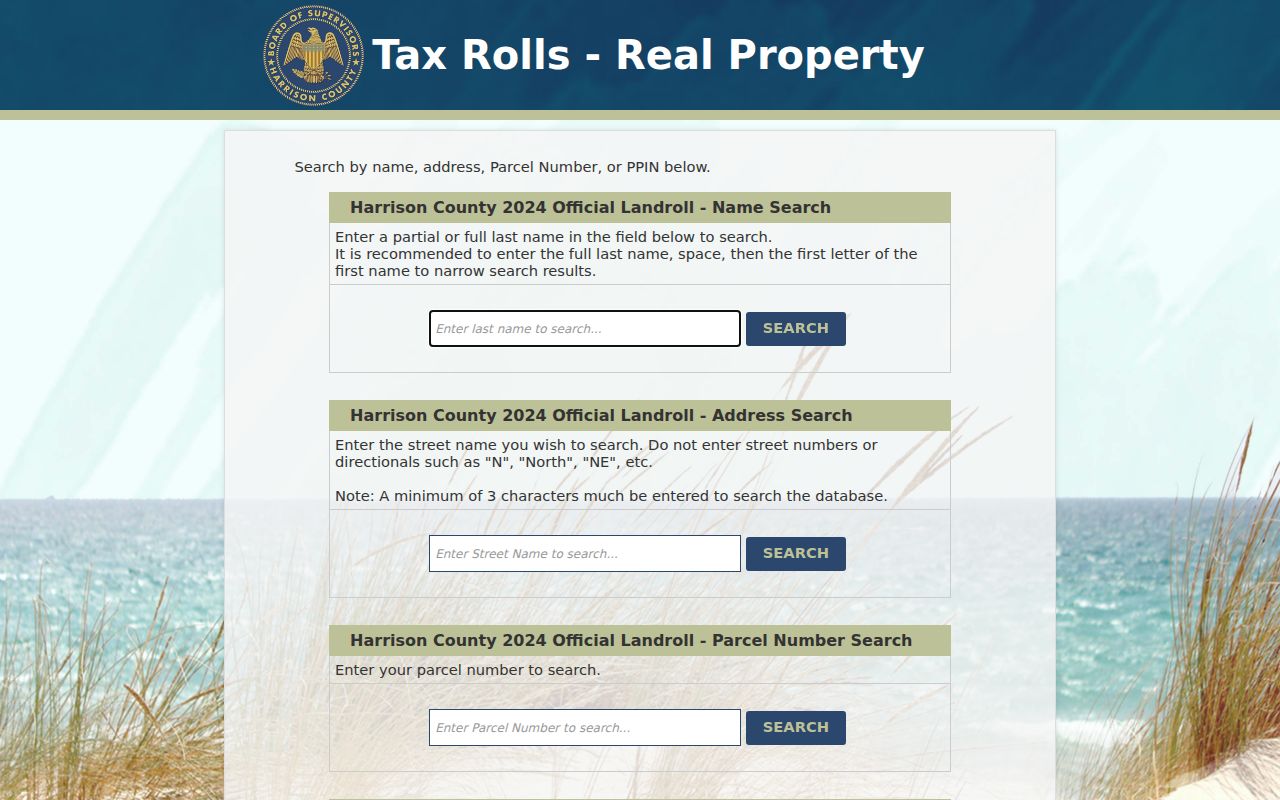
A street search stays useful when the parcel number is unknown. PPIN is the cleaner key for a known account.
Follow a Harrison County Address to Its Tax Bill
A complete lookup begins with assessment. It ends with collection, which keeps a payment screen from being mistaken for the underlying value record.
- Search the official landroll by street, owner, parcel number, or PPIN.
- Confirm the parcel and note the true value, assessed value, class, and any homestead indicator available.
- Carry the PPIN or parcel number to the Harrison County online payment portal.
- Read the bill and payment status, then contact the Tax Collector if an older receipt or non-card method is needed.
- If taxes were sold, verify the sale year and redemption status with the Chancery Clerk's Land Redemption Department.
- Assessed value
- The portion of true value produced by the state class ratio.
- Millage
- The local rate applied to assessed value to calculate tax.
- Homestead exemption
- Relief tied to eligible owner-occupied property and a timely application.
- Tax lien
- A claim arising from unpaid tax; its status must be checked with the responsible office.
Card payments carry a non-refundable 3 percent service fee. That cost belongs to the payment channel. It never touches the assessor's valuation. Confirm office payment alternatives with the Tax Collector, and view the official Harrison County tax payment landing page.

The landing page separates property services from other county payments and shows the service-fee notice before any charge.
Harrison County Homestead Dates Change the Taxable Amount
The Mississippi homestead guidance sets the application window from January 1 through April 1. Applications go through the county Tax Assessor. Use the current state and county instructions for eligibility and required proof.
A homestead entry changes the taxable amount without transferring ownership. It is a tax clue, not a deed. Never rely on it alone. Title and occupancy call for the deed records.
For a missing or disputed indicator, contact the Harrison County homestead staff listed in the assessor directory with your parcel or PPIN, and ask which roll year reflects the application.
Note: A homestead code supports tax classification, but the recorded deed remains the stronger source for legal ownership.
January 1 Anchors Harrison County Property Tax Records
Taxes attach to the January 1 owner of record. Bills go out later, usually November or December. Payment falls due the next February 1. A deed recorded after January 1 can therefore leave the roll name mismatched with a later owner.
State law also requires a full real property reappraisal at least every four years. Damage, demolition, or new construction can shift the roll between those broad cycles. Always pair a copied value with its assessment year.
That is the roll's limit. A tax roll proves a year's liability, never real-time title. For value numbers without the bill process, see the Harrison County property value guide.
When Harrison County Taxes Move From Delinquency to Redemption
A delinquent Harrison County tax bill changes hands as it ages. Current-year property taxes left unpaid by the last Monday in August are sold at a Tax Collector auction. That is according to the Chancery Clerk. The owner then has two years to redeem. That redemption runs through the Chancery Clerk's Land Redemption Department, not the Tax Collector.
Start with the payment route and search for the parcel and year there. If nothing shows, ask the Tax Collector for the delinquent roll or the auction entry. Once a parcel has been sold, Land Redemption can supply the sale date and the amount. It can also name the purchaser, the redemption deadline, and whether a release or deed has issued. The county publishes no downloadable foreclosure or delinquent-property list, so these answers come by request.
One caution. A tax-sale entry alone does not prove that ownership finally changed. Redemption, cancellation, a later deed, or a court order can each alter the outcome. So read the full sequence before drawing a conclusion about who holds title.
Contest a Harrison County Assessment on Time
Start with the property record itself. Review it with the Tax Assessor. Pin down the factual point at issue, whether that is classification, parcel identity, physical characteristics, or value. The right support depends on the dispute. A recent appraisal and photographs can strengthen a value objection. Measurements, repair evidence, and comparable sales can help too. When the parcel itself is wrong, bring the correct deed or survey.
Timing matters most. The Mississippi DOR property-tax guidance sets a firm deadline. Objections must reach the county Board of Supervisors before the first Monday in August. Follow the current Harrison County roll and the local filing instructions. Asking the office a general question is not the same as filing an objection.
Appeal window. File the Harrison County objection before the first Monday in August; missing that statutory window can postpone formal review.
The local Board step is not the end of the road. The state appeal-process page lays out the later administrative review available to a Harrison County owner whose objection fails, and an assessment appeal is a separate matter from a private appraisal.
Limits of Harrison County Property Tax Records
Harrison County tax records answer two questions well: what the property was valued at, and whether the bill was paid. They do not prove lot corners. They will not surface every private lien. The owner field can also lag behind a closing that occurred after the annual assessment date, and a payment made by one person does not establish title in that person's name.
Value limit. Harrison County assessed value exists for taxation; it is not a certified appraisal or a prediction of the property's sale price.
Keep each office in its lane. The assessor maintains the roll. The Tax Collector handles payment. The Chancery Clerk holds redemption files and recorded ownership evidence, and holding those roles apart is the simplest way to read Harrison County property tax records without asking one field to carry more weight than it has.