
Trace Back Harrison County Former Property Owners
Work backward from the newest deed to older instruments. Harrison County maintains two judicial districts, and their digital scan coverage starts in different eras. Track district and record reference at every step.
| Transfer point | Grantor to grantee | Record type | Reference to save |
|---|---|---|---|
| Newest conveyance | Previous holder to current grantee | Recorded deed | Instrument or book/page |
| Prior conveyance | Earlier holder to that former owner | Recorded deed | Earlier book/page |
| Subdivision origin | Developer or predecessor to lot owner | Deed and plat | Plat plus deed cross-reference |
| Pre-digital link | Earlier grantor to grantee | Historic deed book | Sectional index and page |
Take dates and names from the instruments. The legal description is what ties generations together when a street is renamed or one parcel splits into several.
Go Back Through Harrison County's Two Digital Baselines
The Chancery Clerk's scan project began in 2021. Its notice carries District 1 deed books back to 1943 and District 2 books back to 1959. Sectional indexes were added too. District 1 is released, and District 2 status can be confirmed with the Clerk. Those years measure digitization reach, not the birth of county ownership records. The Virtual Index provides a record-type selector, book selector, page entry, official-record display, and district-specific help. Historic images are informational. Official records can be purchased.
Online cutoff. The verified scan reaches 1943 for District 1 and 1959 for District 2. Continue older former-owner work in deed books, microfilm, and archives.
Reconstruct the Harrison County Deed Chain Backward
Enter the chain through the current parcel. After that, each recorded transfer supplies the next former owner and record key, so the documents carry the search themselves.
- Find the current grantee's incoming deed in the land index.
- Save its grantor, date, deed type, legal description, and instrument or book/page.
- Search that grantor as an earlier grantee and confirm the same land description.
- Repeat through the sectional index and historic books when online name search ends.
- Grantor
- The party conveying an interest.
- Grantee
- The party receiving that interest.
- Chain of title
- The ordered set of land transfers.
- Quitclaim and warranty deeds
- Different forms whose terms must be read in the instrument.
Go Back Beyond Harrison County's Web Index
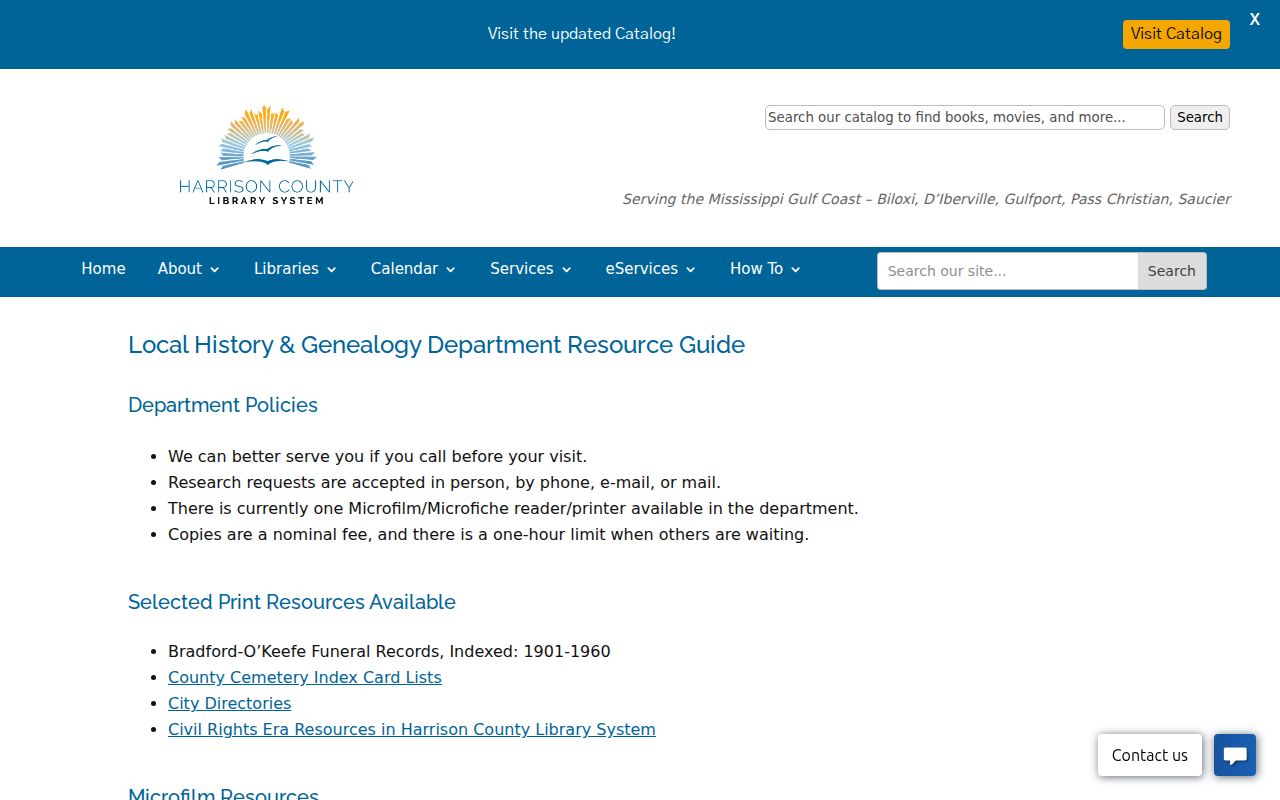
The Harrison County Library System genealogy guide lists deed records from 1841 through 1886, with an index running through March 1889. It also lists nonconsecutive tax assessments from 1832 through 1890. Those rolls are strong prior-owner leads. Turn to them whenever the digital chain stops. The collection does not circulate. A microfilm reader is available on site. Call the Biloxi research center before visiting, since use may be limited to an hour when busy, and nominal copy charges apply. MDAH county series and the FamilySearch Harrison wills catalog add archive and probate routes.
A tax assessment can bridge quiet years between deeds. A will or estate file may explain a break in the ordinary grantor-grantee trail, so probate deserves a look too.
Rebuild Harrison County Ownership History After Katrina
Hurricane Katrina flooded the former local-history building with several feet of water, storm debris, and aquatic life. The genealogy department moved through temporary sites before reaching its downtown Biloxi facility. Irreplaceable material was lost or displaced. That loss argues for comparing repositories. Check library holdings against Chancery deed books, MDAH records, and probate files. A missing library item is not a lost instrument.
Resolve Harrison County Chain Breaks and Renamed Streets
A sale-to-sale line breaks in familiar ways. Estates, partitions, lot splits, releases, court orders, and re-parceling all interrupt the sequence. The county estate index holds about 8,828 names and cause numbers, yet it is expressly incomplete. Request the full file when probate explains a transfer. Biloxi's Miramar history records Wilkes Avenue becoming Swetman Street. County municipal lines also changed through annexation. Search under both street names, then use subdivision, lot, block, section, parcel, and plat evidence to reconnect the land. Note: A directory occupant or old assessment name is a lead to former owners, not proof that the person held title.
Browse Harrison County Sectional Indexes Before Images
An old address rarely works as a direct historic-image query. Start in the sectional index instead. Identify the deed book, volume, page, and record type, then use View Official Record, where the portal offers previous and next controls, a page jump, printing, and a purchase action. Preserve the book and page at every generation. A modern address may not appear in the deed, but section-township-range or lot-and-block detail can survive owner variants and street changes. District-specific help documents are linked in the portal.
Request a Harrison County Former-Owner Record Offline
Fall back on the Chancery Clerk's phone and copy route, the library, or the archives when the image falls short. The Gulfport vault is closed to walk-ins. Contact recording or vault staff and give the district, book/page or instrument number, type, date range, and legal description. Harrison County's written public-record process allows email or delivery. Its policy allows seven working days for an estimate or response and production within fourteen days after payment. Paper copies are $0.50 per page. Applicable search, review, redaction, retrieval, and mailing costs can be added. Deed-image charges may follow a separate route.
Measure How Far Back Harrison County Former Owners Go
Former owners reach well past the scan baselines. Nineteenth-century deed and assessment runs, MDAH archives, plats, court files, and Chancery volumes can extend the work. Their years overlap imperfectly. The stopping point depends on both parcel and source. When online access fails, write down the district, sectional reference, book/page, legal description, and date interval. The Chancery Clerk holds the official land record. The library holds microfilm, and the Harrison County deed page covers a single copy once its reference is known.
Lawful use. Former-owner records support house history, estate work, and property diligence. Never use a historic chain to stalk, harass, threaten, or harm a living person.
Bridge Harrison County Deed Gaps With Tax Rolls
A tax roll can anchor a name to land. It does so even in a year with no deed transfer at all. That makes the library's assessment runs, though nonconsecutive from 1832 through 1890, genuinely useful. They show whether a former owner still stood beside the tract between conveyances. Treat each entry as supporting evidence, since assessment and title are not the same thing.
A year-by-year worksheet keeps the work honest. Give it columns for the assessment name, deed grantor, deed grantee, legal description, and source. When a tax name shifts without a matching deed, test probate, partition, sheriff or tax proceedings, and court orders. When the parcel description itself changes, inspect the plat and the predecessor parcel. Do not simply assume an owner swap.
Harrison County's historic record also holds wills from 1854 through 1921 at the library. It holds marriages from 1841 through 1931. It also holds administrator, executor, and guardian bonds from 1851 through 1902. FamilySearch catalogs a will index spanning 1853 through 1927. These records can reveal the estate or family tie behind a transfer. Even so, the Chancery instrument remains the bridge back to the land itself.
Twentieth-century address work has its own tool. The Coast Cross Reference Directory covers 1986 through 1995, plus 1997, 2000, 2001, and 2004. A listed subscriber might be a relative, a business, or an occupant. The subscriber might not be the owner of record. Confirm every directory name against the assessment and deed chain before adding anyone to a former-owner list.
The safest chronology states both the evidence and its limits. Mark the missing years. Distinguish recording date from execution date. Never let a silent gap become an invented transfer.
Keep deed type visible in the timeline too. A quitclaim, warranty deed, trustee instrument, executor deed, court decree, or release does not play the same role. A familiar name alone does not change that. Read what interest was conveyed and whether the legal description matches the same tract. If an instrument cites an earlier deed, follow that reference before falling back on a broad name search. That cross-reference often slips past spelling changes and common surnames.